

NASA has unveiled the first images showcasing a massive crater carved into an asteroid following a groundbreaking spacecraft collision at an astonishing speed of approximately 14,000 miles per hour. This dramatic impact marks a significant milestone in planetary defense, demonstrating humanity’s ability to alter the trajectory of a celestial object threatening Earth.
The DART Mission: What Happened?
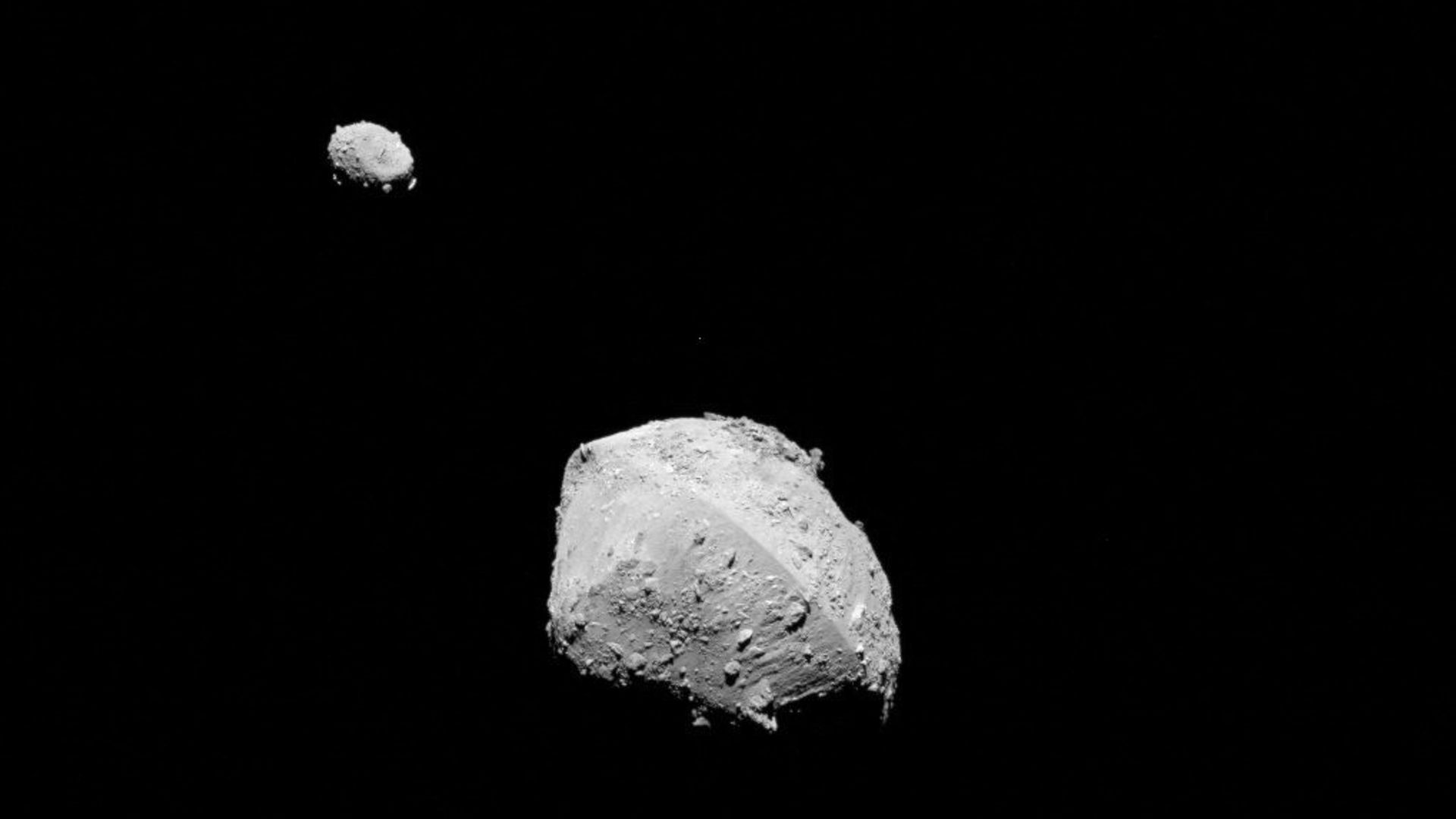
In a mission aptly named the Double Asteroid Redirection Test (DART), NASA intentionally directed a spacecraft to collide with the asteroid Dimorphos, a small moonlet orbiting the larger asteroid Didymos. The spacecraft struck Dimorphos at roughly 14,000 mph, creating a crater roughly the size of a stadium. The goal was to test whether such a kinetic impact could effectively nudge an asteroid off its original path, providing a viable method to protect Earth from potential asteroid threats in the future.
The released images reveal a stark, newly formed crater on Dimorphos’ surface, confirming the success of the impact. This direct evidence underscores the mission’s effectiveness in altering the asteroid’s momentum, a critical proof-of-concept for planetary defense strategies.
Why This Mission Matters
Asteroids and other near-Earth objects (NEOs) pose a real threat to our planet, capable of causing catastrophic damage if one were to collide with Earth. Historically, humanity has lacked practical methods to prevent such an impact. The DART mission changes that paradigm by showcasing a tangible technique to deflect an asteroid.
Dimorphos, the target of the mission, is representative of many small bodies in space that could intersect Earth’s orbit. By successfully shifting its trajectory through kinetic impact, NASA has demonstrated a scalable defense mechanism. This test is especially crucial as it provides data to refine models predicting how asteroids respond to forceful impacts, which will inform future mitigation efforts.
Moreover, the mission illustrates international collaboration and technological prowess. NASA worked alongside partners, including the European Space Agency (ESA), which plans to launch the Hera spacecraft to further study the aftermath of the DART impact by surveying Dimorphos in detail. This cooperation exemplifies global commitment to planetary safety.
Looking Ahead: The Future of Planetary Defense
The DART mission’s success opens new avenues for protecting Earth from asteroid threats. Scientists and engineers can now analyze the crater’s dimensions, assess changes in the asteroid’s orbit, and better understand the physical properties of such space rocks. These insights will allow for more precise deflection strategies and early intervention plans.
Future missions will likely build on DART’s foundation, possibly involving multiple spacecraft or alternative deflection techniques like gravity tractors or even controlled nuclear detonations, depending on the size and trajectory of a threatening object. The data gathered from this mission ensures that humanity is better prepared than ever before.
In essence, the stadium-sized crater left by NASA’s spacecraft is not just a mark on a distant asteroid; it symbolizes a giant leap forward in safeguarding our planet. As space agencies continue to monitor and study near-Earth objects, the lessons learned from DART will be indispensable in shaping a safer future.
What this means: The ability to intentionally alter an asteroid’s course transforms planetary defense from theory into reality. While no immediate threats loom, this mission equips humanity with a tested tool to counter potential cosmic hazards, reinforcing Earth’s defense shield and underscoring the critical importance of continued space exploration and vigilance.