

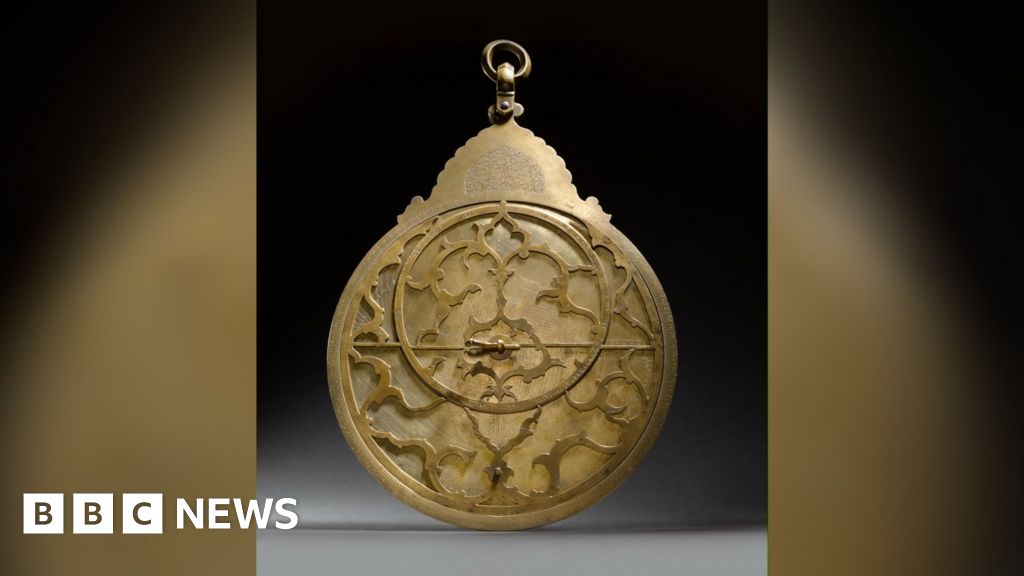
A remarkable 17th-century brass astrolabe, once owned by the royal family of Jaipur in western India, has shattered auction records by selling for over £2 million ($2.75 million) in London. This extraordinary astronomical instrument, hailed as a “supercomputer” of its time, is now the most expensive Islamic astronomical artifact ever sold at auction.
What Is the Jaipur Astrolabe and Why Is It Unique?
The astrolabe is a sophisticated hand-held device used historically for astronomical calculations. Crafted from brass, this particular piece is believed to be the largest surviving astrolabe in existence. Its intricate design features multiple interlocking layers of finely engraved metalwork, enabling users to perform complex celestial measurements.
Benedict Carter, head of Islamic and Indian Art at Sotheby’s, noted that this astrolabe had never before been publicly displayed, making the auction a rare opportunity to witness a masterpiece of scientific craftsmanship from the 17th century.
Astrolabes functioned as multi-purpose instruments, capable of telling time, mapping stars, determining the direction of Mecca for prayers, and tracking the movements of celestial bodies. They represent a two-dimensional projection of the three-dimensional universe, akin to an analog computer of the pre-modern world.
The Astrolabe’s Royal Heritage and Journey
This extraordinary instrument once belonged to Maharaja Sawai Man Singh II, the last ruling Maharaja of Jaipur, renowned for his patronage of the arts and sciences. Upon his death, the astrolabe was inherited by his wife, Maharani Gayatri Devi, a celebrated icon of glamour and progressive influence in 20th-century India.
During Maharani Gayatri Devi’s lifetime, the astrolabe transitioned into a private collection and remained largely hidden from public view until Sotheby’s brought it to auction. Its provenance adds significant historical and cultural value, connecting it to a period when Indian royalty embraced scientific innovation alongside traditional arts.
Why This Astrolabe Matters: The Intersection of Science, Culture, and History
Dr. Federica Gigante of the Oxford Centre for History of Science, Medicine and Technology explains the astrolabe’s significance by comparing it to today’s smartphones. “You can calculate the time of sunset, sunrise, the height of a building, the depth of a well, distance and even use them to predict the future,” she says. Astrolabes were indispensable tools for astronomers, navigators, and astrologers alike.
In addition to celestial navigation and timekeeping, astrolabes were used in conjunction with almanacs to cast horoscopes, reflecting the device’s deep integration into both scientific inquiry and spiritual practice in the Islamic world and beyond.
This particular astrolabe exemplifies the advanced state of scientific knowledge and craftsmanship in 17th-century India, a time when Islamic and Indian scholars collaborated and innovated in fields like astronomy, mathematics, and geography.
What This Record Sale Tells Us
The record-breaking sale of the Jaipur astrolabe underscores a growing global appreciation for historical scientific instruments and the rich cultural heritage they represent. It also highlights the significant role of Indian and Islamic contributions to the history of science, often overshadowed in mainstream narratives.
Collectors and institutions are increasingly recognizing these artifacts not just as works of art, but as tangible links to the intellectual achievements of past civilizations. The Jaipur astrolabe’s sale signals a renewed interest in preserving and studying such objects to better understand the complex history of science and technology worldwide.
As these masterpieces resurface in the public eye, they offer invaluable insights into how earlier societies viewed the cosmos and navigated the world—lessons that continue to inspire scientific curiosity and cultural pride today.