

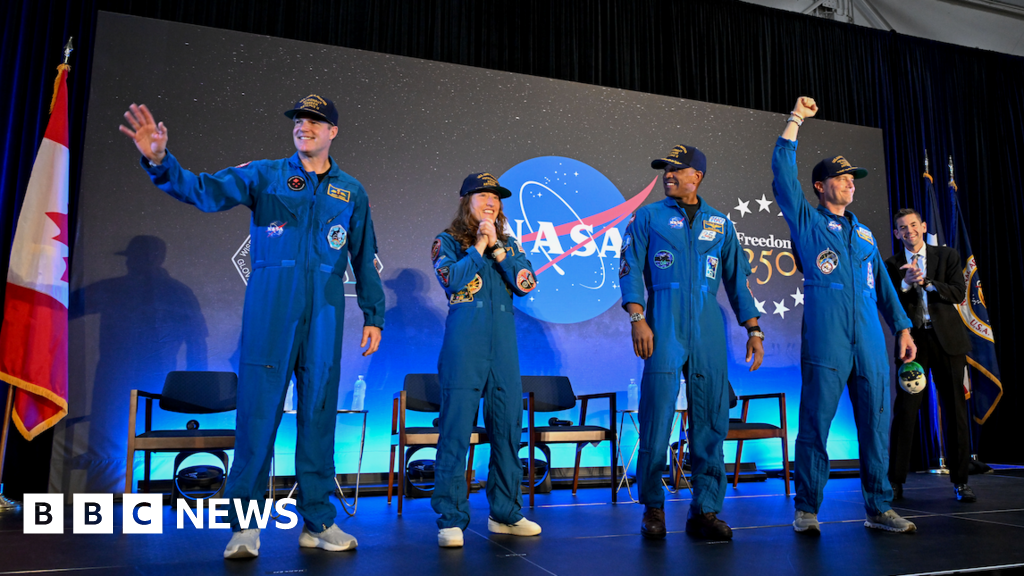
The crew of NASA’s Artemis II mission returned not only with groundbreaking technical achievements but also with a profound message of hope and unity that resonates across the globe. In their first public news conference since safely returning last Friday, astronauts Reid Wiseman, Victor Glover, Christina Koch, and Jeremy Hansen opened up about how their journey beyond the Moon deepened their connection to each other—and to humanity itself.
A Mission Beyond Technology: The Human Connection
While the Artemis II mission marked a significant milestone in space exploration, the astronauts emphasized that its true impact goes far beyond scientific and engineering triumphs. The crew described how the experience forged bonds that transcend language and nationality, uniting them through shared moments of laughter, joy, and even tears.
“We left as friends and came back something closer,” said Wiseman. “It’s hard to put into words what we experienced, but it reminded us all what it means to be human.”
This profound sense of unity reflects the original spirit of space exploration—bringing people together to achieve something greater than any one nation or individual could accomplish alone. The Artemis II team conveyed how their journey rekindled an instinct to reach out and support one another, breaking down borders and differences.
Inspiring a Planet: The Global Impact of Artemis II
At NASA’s Johnson Space Center in Houston, the astronauts expressed awe at the worldwide response to their mission. The overwhelming support and pride from people around the world reaffirmed the crew’s belief that Artemis II was about more than just reaching the Moon—it was about inspiring hope at a time when unity can feel elusive.
“We wanted to do something that would bring the world together,” Wiseman told reporters. “We were hooked on the mission, but when we came home, the global outpouring of support was amazing. We want to thank the world for tuning in and joining us on this journey.”
This reaction highlights how space exploration continues to serve as a powerful symbol of international cooperation and shared human achievement. The astronauts see Artemis II as proof that even in challenging times, humanity can unite around a common goal and push the boundaries of what’s possible.
Integrity and Partnership: The Heart of Artemis II’s Success
The astronauts also praised the Orion spacecraft, affectionately named Integrity, and the Space Launch System (SLS) rocket, which propelled them on their historic voyage. These engineering marvels stand as testaments to the power of collaboration across countries, industries, and disciplines.
“Integrity and the SLS represent what international partnership can still produce,” Wiseman said. “Every person who had a hand in building that machine should be proud—it was magnificent.”
This acknowledgment reflects a broader narrative that Artemis II embodies: the future of space exploration depends on cooperation. As nations pool resources and expertise, missions like Artemis II will pave the way for more ambitious endeavors, including returning humans to the lunar surface and eventually venturing to Mars.
Why Artemis II Matters: A Forward-Looking Perspective
Artemis II’s success signals a new era for space exploration—one where landing on the Moon is no longer a distant dream but an achievable reality. The mission’s technological breakthroughs and the crew’s inspiring message remind us that space exploration remains a powerful catalyst for scientific discovery, innovation, and global unity.
For the public, the astronauts’ reflections offer something equally vital: hope. In a world often divided by politics, culture, and conflict, Artemis II rekindles the belief that humanity can come together to accomplish extraordinary feats.
As NASA and its international partners prepare for future Artemis missions, the lessons and spirit of Artemis II will serve as a guiding light. The mission proved that when people unite behind a common vision, the sky is not the limit—it’s only the beginning.