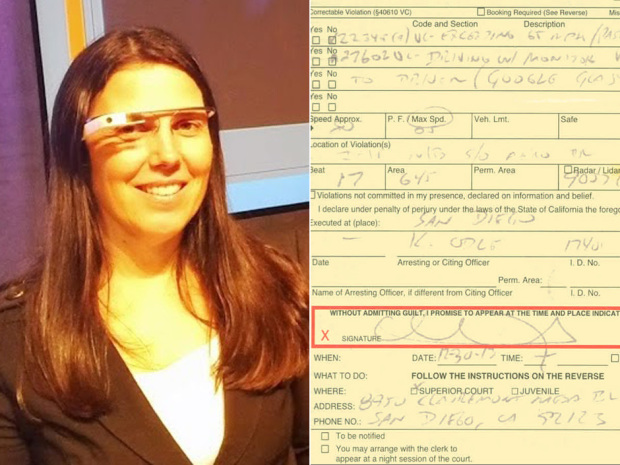
A groundbreaking legal decision has emerged from San Diego, where a woman accused of driving while wearing Google Glass has been officially cleared of any wrongdoing related to distracted driving. This landmark case marks the first recorded instance of a traffic violation allegation involving Google’s innovative computer eyeglasses, and its outcome could have far-reaching implications for the regulation of wearable technology on the road.
The Incident and Legal Proceedings
In October of the previous year, Cecilia Abadie, a software developer and one of the early adopters of Google Glass, was stopped by law enforcement for speeding. During the stop, the officer issued a traffic citation not only for speeding but also for reportedly using a visible “monitor” while driving. This charge typically applies to drivers caught watching television screens or other distracting video devices behind the wheel.
The allegation that Ms. Abadie was operating Google Glass, essentially a miniature computer screen worn like eyeglasses, while driving raised novel questions about the applicability of existing distracted driving laws to emerging wearable technologies. The case proceeded to a traffic court trial in San Diego, attracting attention because it tested how legal systems might approach new devices that blend computing and communication seamlessly into everyday accessories.
At trial, Court Commissioner John Blair examined the evidence and testimony thoroughly. He ultimately concluded that there was no proof Ms. Abadie had the Google Glass device powered on or actively in use while she was driving. Consequently, the commissioner dismissed the charge related to the visible monitor. He also ruled that the speeding ticket lacked sufficient grounds and ordered its dismissal.
This decision underscored a key legal nuance: simply wearing a device is not equivalent to using it in a way that violates traffic laws, especially when the device’s screen remains off unless deliberately activated by the user.
Understanding Google Glass and Its Unique Features
Google Glass represents a pioneering advance in wearable technology. The device consists of a lightweight frame fitted with a tiny, transparent display positioned just above the right eye. Unlike traditional screens that are easily visible to others, this display is designed to be visible only to the wearer, making it nearly impossible for law enforcement to determine at a glance whether the device is on or off.
The device allows users to engage in a variety of digital activities hands-free, including taking photographs, recording videos, sending messages, and accessing information through voice commands or touch-sensitive controls on the frame. Connectivity is achieved through wireless signals, either via Wi-Fi hotspots or tethering with mobile phones.
Despite its futuristic capabilities, Google Glass had not yet been widely released to the public at the time of Ms. Abadie’s citation. She was among an exclusive group of roughly 10,000 “explorers” who received early access to the device as part of a limited trial program earlier that year.
Google had not announced an official public launch date, though industry speculation pointed toward a general release sometime in early 2014. This exclusivity and limited distribution made this court case especially significant, as it provided one of the earliest real-world legal tests of how such wearable technology fits into existing laws.

What This Means for the Future of Wearable Tech and Driving Laws
The verdict in Ms. Abadie’s case sets an important precedent regarding the interpretation of distracted driving laws in the context of emerging devices. As wearable technology like Google Glass becomes more mainstream, lawmakers and courts will increasingly face challenges balancing innovation with public safety.
Ms. Abadie herself emphasized responsible use, noting that Google’s official guidance encourages users to “be responsible” when wearing Glass. She explained that the device’s screen does not activate automatically; instead, it only lights up upon explicit commands from the wearer, which she argued minimizes distraction.
This case highlights the need for nuanced legislation that distinguishes between passive use and active engagement with technology while driving. Unlike traditional screens that occupy a driver’s visual field, Google Glass’s design aims to reduce distraction by limiting visibility to the user alone and requiring intentional activation.
For policymakers, the ruling signals the importance of crafting laws that consider the unique characteristics of new technologies rather than applying outdated frameworks designed for older devices. For drivers, it serves as a reminder that responsible use and awareness remain paramount when interacting with any technology behind the wheel.
As wearable technology evolves and becomes more integrated into daily life, legal systems worldwide will likely encounter similar cases. The outcome of Ms. Abadie’s trial offers early guidance on how courts might approach these issues, balancing innovation with road safety considerations.
Ultimately, this landmark decision opens the door for more informed discussions about how to regulate emerging technologies fairly and effectively, ensuring that the benefits of innovation do not come at the cost of public safety.