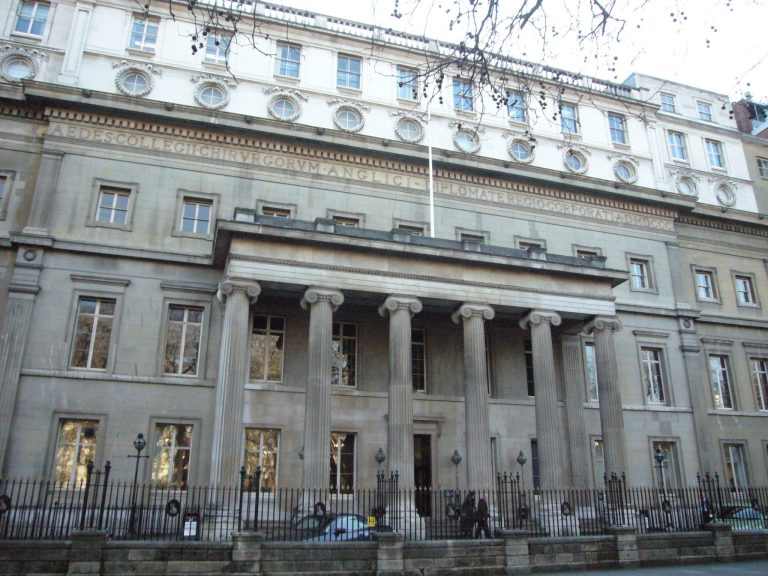
John Hunter’s collection was purchased by the government in 1799 and given to the Company (later The Royal College) of Surgeons. The collection formed the basis for a museum constructed as part of the new Royal College of Surgeons of London’s building on the south side of Lincoln’s Inn Fields.
This first museum, designed by George Dance and Nathaniel Lewis, was soon found to be inadequate; as early as 1829 William Clift complained of a ‘great inconvenience’ from ‘want of space’. It was decided that the whole building should be redesigned, and Charles Barry was selected as the architect for the project. The museum closed in April 1834 and reconstruction began. Elements of the Dance/Lewis structure were retained but the original gallery was extended and a second gallery added – these were known as the East and West museums respectively and were completed in February 1837. Continued expansion of the collections forced a further extension, again to Barry’s design, which started in 1851 and was completed in 1852. This created a third room with the three now designated as the East, Middle and West museums.
Further minor alterations to the structure and more significant reorganisations of the displays took place between the mid 1850s and the late 1880s, when two further galleries were added (these were begun in 1888 and completed in 1892). They were completed in the same style as Barry’s earlier rooms, and the five galleries were numbered I-V. In addition there were several smaller rooms that were variously used as workrooms or display areas annexed to the museum. They included rooms used for the display of the growing collection of surgical instruments, as well as rooms for items such as mummies and other objects that did not fit into the main collection series.
A major addition to the museum took place in 1909 when the College received on loan the collection of the Odontological Society of Great Britain. It was housed in a new gallery under the existing Room II. Further subterranean extensions were made in 1921, when a room was added under the Instrument Room at the rear of Room V to house the Army Medical Collection, and in 1925, when the osteological series was accommodated below Room I.