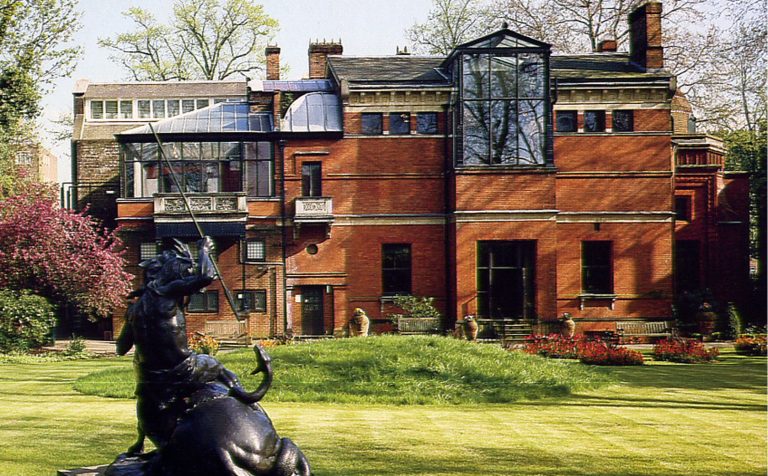
‘He built the house as it now stands for his own artistic delight. Every stone of it had been the object of his loving care. It was a joy to him until the moment when he lay down to die.’
Leighton’s sisters in a Letter to The Times, 26 January 1899
Leighton acquired the plot for his house in 1864 and began making plans for its construction. For a number of years he had harboured the idea of building a purpose-built studio-house and had an ‘old friend’ in mind to act as his architect.
Leighton’s Architect
George Aitchison (1825-1910) first met Leighton in Rome in the early 1850s. He was the son of an architect and the family practice had specialised in wharves, warehouses, docks and railway architecture. When Leighton commissioned him, Aitchison had designed no houses and would be responsible for just a single further example in the future. Nevertheless, his involvement with Leighton’s house extended over 30 years and changed his career. Through his work for Leighton he was engaged by a series of wealthy and artistically-inclined clients to remodel and decorate the interiors of their London homes. Sadly very little of this work has survived and Aitchison’s reputation has largely gone with it. But as both Professor of Architecture at the Royal Academy and President of the Royal Institute of British Architects, Aitchison was a prominent and respected figure in the architectural world of the late nineteenth century.
The First Phase of Construction
Work started on the house in 1865 and continued while Leighton took an extended tour of Spain. In October he was in Rome and was able to move- in on his return. Externally, the new house was strikingly plain, with little ornament or embellishment. The south facade, facing the street, was given the appearance of an Italian palazzo. The north facade overlooking the garden was dominated by the large studio window on the first floor. Internally the house was relatively modest at this stage, consisting of just a dining room, drawing room, breakfast room and staircase hall on the ground floor. Upstairs were just two rooms; Leighton’s great painting studio and his surprisingly modest bedroom.
The First Extension: 1869-70
Within three years of the house being completed, Leighton undertook the first of what would be a series of extensions and alterations. In order to increase the size of the studio on the first floor, the east wall was taken down and the house extended by some 5 metres. The extension incorporated a new canvas store accessed via a trap-door in the floor of the studio.