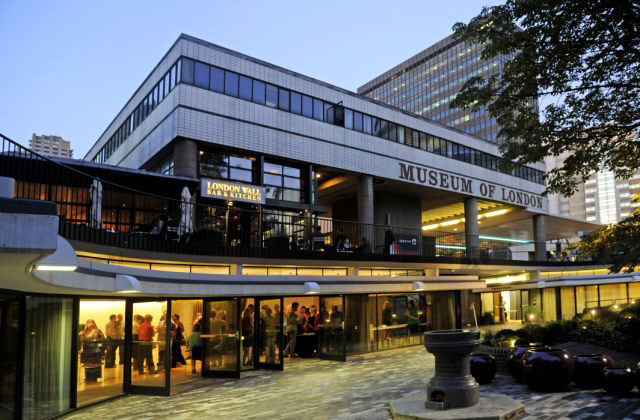
The Museum of London documents the history of London from prehistoric to modern times. The museum is located on London Wall, close to the Barbican Centre as part of the striking Barbican complex of buildings created in the 1960s and 1970s as an innovative approach to re-development within a bomb-damaged area of the City of London.
It is a few minutes’ walk north of St Paul’s Cathedral, overlooking the remains of the Roman city wall and on the edge of the oldest part of London, now its main financial district. It is primarily concerned with the social history of London and its inhabitants throughout time. The museum is jointly controlled and funded by the City of London Corporation and the Greater London Authority.
In March 2015, the museum announced plans to move from its Barbican site to nearby Smithfield Market. The move, contingent upon raising an estimated £70 million, is planned to be complete by 2021.
The amalgamation of the collections previously held by the City Corporation at the Guildhall Museum and of the London Museum, which was located in Kensington Palace was agreed in 1964. The Museum of London Act, allowing for the merger, was passed in the following year.
The museum was opened in December 1976 as part of the Barbican Estate, The architects were Philip Powell and Hidalgo Moya, who adopted an innovative approach to museum design, whereby the galleries were laid out so that there was only one route through the museum – from the prehistoric period to the modern galleries.
The museum comprises a series of chronological galleries containing original artefacts, models, pictures and diagrams, with a strong emphasis on archaeological discoveries, the built city, urban development and London’s social and cultural life, with interactive displays and activities for all ages. Fragments of the Roman London Wall can be seen just outside the museum. The prehistoric gallery, “London Before London” and the “Medieval London” gallery have already been updated, and in 2010 a refurbished gallery on “War, Plague and Fire” opened, covering the period of the English Civil War and the Great Fire of London.
The museum had a £20 million redevelopment which was completed in May 2010. This is its biggest investment since opening in 1976. The re-design, by London-based architects Wilkinson Eyre, tells the story of London and Londoners from the Great Fire of 1666 to the present day. The transformation includes four new galleries. The new City Gallery features large street level windows along London Wall and provides an illuminated showcase for the Lord Mayor’s State Coach, which takes to the streets each November for the Lord Mayor’s Show.
The Galleries of Modern London increased the museum’s exhibition space by 25 percent and enabled the display of 7,000 objects. Star exhibits include a reconstruction of Georgian pleasure gardens, the foreboding wooden interior of the Wellclose debtors prison cell, an art deco lift from Selfridges department store and the puppet stars of BBC children’s TV Andy Pandy and Bill and Ben.
The “Expanding City” gallery covers the period 1660s to 1850. “People’s City” addresses 1850 to 1940s, including a “Victorian Walk” with recreated shops and public buildings, and sections on the West End, Suffragettes, World War I and World War II, and everyday life.
The new galleries place a renewed emphasis on contemporary London and contemporary collecting. “World City” is the gallery which tells London’s story from 1950 to the present day. Fashion looms large here – from formal suits of the 1950s, through to the Mary Quant dress of the swinging 1960s, hippy chic in the 1970s and the bondage trousers and ripped T-shirts of the punk era. Fashion comes right up to date with a pashmina from Alexander McQueen’s 2008 collection.
The Sackler Hall contains an elliptical LED curtain where the work of up-and-coming young filmmakers is screened in a bi-annual Museum of London Film Commission, in association with Film London. A temporary exhibition space, “Inspiring London”, features a changing programme of displays on the theme of creativity and inspiration.
This October – for the first time ever – never-before-seen objects from the Metropolitan Police’s Crime Museum will go on public display in a major new exhibition opening at the Museum of London.
Since its establishment by serving officers in the mid-1870s the Crime Museum has previously only been open to police professionals and invited guests. Now, using original evidence from this extraordinary collection, we’ll unlock real-life case files to take you on an uneasy journey through some of the UK’s most notorious crimes from Dr Crippen to the Krays, the Great Train Robbery to the Millennium Dome diamond heist.
Created with the support of the Metropolitan Police Service and the Mayor’s Office for Policing And Crime (MOPAC), the exhibition will consider the changing nature of crime and advances in detection over the last 140 years, as well as the challenges faced in policing the capital, such as terrorism, drugs and rioting.
Giving voice to the real people – victims, perpetrators and police officers – behind these objects we’ll explore the impact of crime, personalising what is so often depersonalised. Confronting how, as a society, we respond when normality is shattered and lives are torn apart, we’ll also be forced to question our enduring fascination with this hidden collection and its stories.
The Crime Museum Uncovered will be accompanied by a programme of talks and events.
Images above, from left to right: The Krays – briefcase with syringe and poison; Counterfeiting and forgery implements; Masks used by the Stratton Brothers, 1905; Objects relating to the murder of Mrs Olive Durand-Deacon by John Haigh (the ‘Acid Bath Murderer’), 1949.
All objects courtesy of the Metropolitan Police’s Crime Museum, New Scotland Yard. All images © Museum of London. Curated from the collections of the Metropolitan Police.