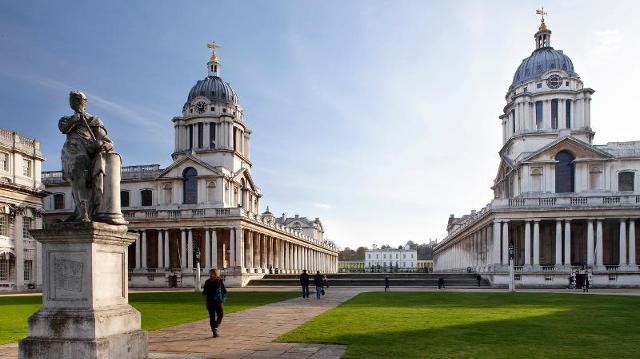
As the centrepiece of the Maritime Greenwich World Heritage Site, the classical buildings that collectively form the Old Royal Naval College were designed by some of England’s most renowned architects and are considered to be amongst the finest in Europe.
The history of the site is as rich as it is complex. Originally occupied by Bella Court, a manor house built in the 1420s by Humphrey, Duke of Gloucester, it was later acquired by Queen Margaret of Anjou, who extended it to create the Palace of Pleasaunce or Placentia.
After being rebuilt by Henry VII as Greenwich Palace in the late 1490s, it developed into a favourite royal residence of the Tudors and was the birthplace of Henry VIII , Mary I and Elizabeth I. During the English Civil War, however, the palace fell into disrepair, and most of the buildings were subsequently demolished: today only their foundations exist, buried beneath Grand Square.
After his restoration to the throne in 1660, Charles II drew up ambitious plans for another new palace, but finances and enthusiasm soon waned, and only one new wing was actually built. In 1694 this wing (now the eastern range of the King Charles Court), along with the grounds in royal ownership, were granted by William III by Royal Warrant as the site for the Royal Hospital for Seamen, in accordance with the wishes of his late wife, Queen Mary II.
Sir Christopher Wren produced designs for the new Royal Hospital and work commenced in 1696 on the four major buildings, or courts, which eventually were to accommodate over 2,000 veterans of the Royal Navy. Wren’s extensive work commitments elsewhere, however, which included rebuilding St Paul’s Cathedral and the City of London churches, as well as extending Hampton Court Palace, meant that most of the work was carried out by Nicholas Hawksmoor, Clerk of Works from 1698, overseen by Wren and assisted by John James. The final blocks were completed by Thomas Ripley between 1735 and 1751. Further minor additions, alterations and landscaping were carried out over the next century by the Surveyors of the Fabric: James Stuart, John Yenn, Joseph Kay and Philip Hardwick.
Occupation by naval pensioners continued for over a century until reduced numbers finally forced the closure of the Hospital in 1869. The buildings were re-opened in 1873 as the Royal Naval College for the education of officers, with the Joint Services Defence College arriving in 1983. When the Navy left in 1997,an independent charity was established to conserve the site for present and future generations, and create enjoyment, learning and unique cultural experiences for everyone.