

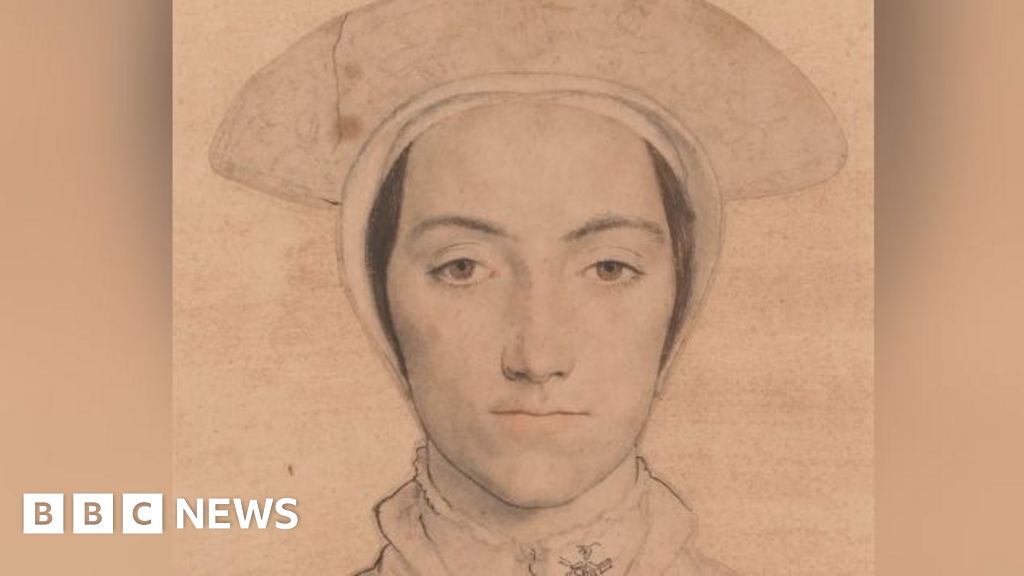
For centuries, the true visage of Anne Boleyn, the infamous second wife of King Henry VIII, has eluded historians and art enthusiasts alike. Despite her pivotal role in English history, no authenticated painting created during her lifetime has survived. However, a tantalizing discovery within the Royal Collection Trust could finally shed light on her appearance: a preparatory sketch marked with her name, attributed to the renowned Tudor artist Hans Holbein the Younger.
The Elusive Portraits of Anne Boleyn
Anne Boleyn’s image has long been the subject of speculation and debate. While several lifelike portraits are believed to represent her, none carry definitive proof of authenticity. Among these, a particular sketch housed in the Royal Collection Trust stands out. This delicate drawing, part of Holbein’s extensive series of Tudor court figures, bears an inscription naming Anne Boleyn, suggesting it could be a contemporary likeness drawn during her lifetime.
Hans Holbein the Younger was the court painter to Henry VIII and famed for his precise and detailed portraits of key figures at the Tudor court. His drawings are invaluable historical documents, capturing the personalities and fashions of the era with remarkable realism. The collection includes numerous sketches of nobles, courtiers, and royalty, making it a crucial resource for Tudor studies.
Art historians like Dr. Bendor Grosvenor support the identification of this sketch as Anne Boleyn. Grosvenor and others argue that the handwriting and style of the label align with Tudor-era annotations, bolstering the claim that this is an authentic contemporary portrait. If true, this piece offers an unprecedented glimpse into the appearance of one of England’s most enigmatic queens.
Controversy and Counterarguments
Despite compelling evidence, some experts remain skeptical. Critics suggest the drawing may have been mislabeled at some point in history, possibly confusing Anne Boleyn’s image with that of another court lady. Given the centuries that have passed and the limited documentation, such errors are plausible.
The debate hinges on multiple factors: the handwriting’s provenance, the sketch’s stylistic elements compared to confirmed Holbein works, and the political and cultural context surrounding Anne’s turbulent life and execution. Some scholars caution against accepting the label at face value without corroborating evidence from other sources.
Nonetheless, written records from the period consistently mention that Holbein produced at least one portrait of Anne Boleyn. This suggests that somewhere within the collection of Tudor drawings lies a true representation of her—if only it can be conclusively identified.
Facial Recognition: A New Tool in Historical Identification
To resolve this longstanding mystery, researchers are exploring modern technology—specifically facial recognition software. This cutting-edge tool has revolutionized fields such as security, law enforcement, and personal device access. Now, it’s being tested as a means to analyze historical portraits and drawings, free from human bias and assumptions.
Using facial recognition, experts can compare features across various Tudor-era portraits thought to depict Anne Boleyn, searching for consistent markers that align with known facial traits of the queen as described in contemporary accounts. This method promises a more objective assessment than traditional art historical techniques, which often rely heavily on subjective interpretation.
However, facial recognition is not without its critics, especially when applied to centuries-old artwork. Challenges include differences in artistic style, the influence of idealization in court portraits, and the varying quality of surviving images. Still, this technology offers a novel avenue to either confirm or challenge previous identifications.
Why This Discovery Matters
The possibility of uncovering Anne Boleyn’s authentic portrait holds significant historical and cultural importance. As a figure whose life and death shaped English history, her true image would deepen public understanding of the Tudor court and the woman behind the legend.
Moreover, confirming a genuine likeness would impact how museums, historians, and educators represent Anne Boleyn, potentially shifting perceptions shaped by centuries of speculation and artistic interpretation. It could also inspire renewed interest in Tudor art and the role of portraiture in documenting history.
Ultimately, this endeavor exemplifies the intersection of history, art, and technology. By harnessing innovative tools alongside traditional scholarship, researchers edge closer to solving one of the most intriguing puzzles of the Tudor era.
What comes next? The ongoing analysis of Holbein’s drawings, combined with advancing facial recognition technology, promises further revelations. As experts continue to investigate, the hope remains that Anne Boleyn’s true likeness will finally emerge from the shadows of history.