

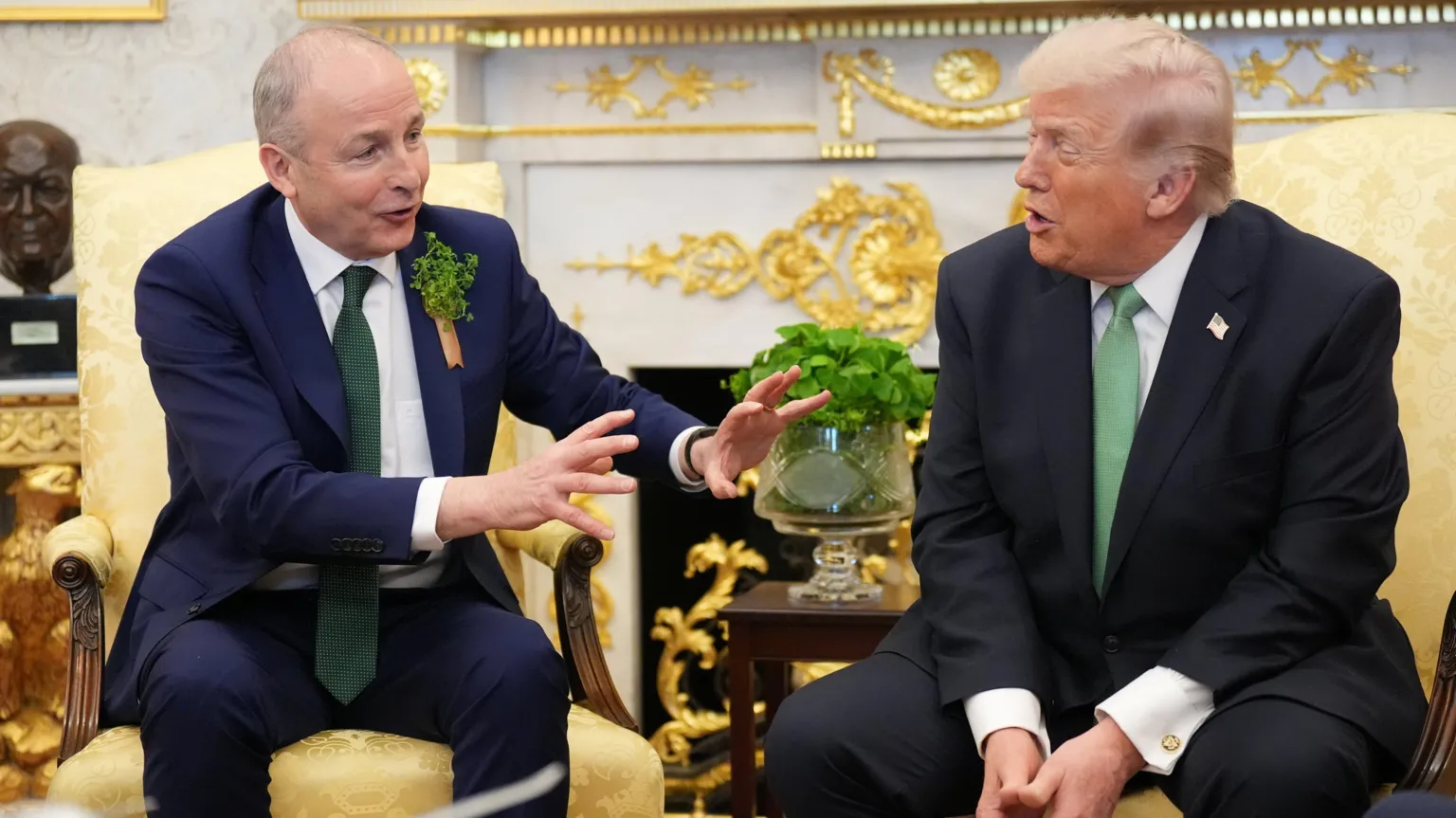
Taoiseach Micheál Martin brought more than diplomatic skill to his meeting with US President Donald Trump on St Patrick’s Day in Washington — he relied on his boxing instincts honed during years as an amateur fighter. The encounter in the Oval Office quickly turned into a high-stakes sparring match over Middle Eastern conflicts, Anglo-Irish relations, and political leadership, testing Martin’s agility both verbally and strategically.
The High-Stakes Meeting: What Transpired in the Oval Office?
Each year, the Irish Taoiseach visits the US to mark St Patrick’s Day with a White House audience, but this year’s meeting was unusually charged. The conversation swiftly shifted to the Middle East, particularly the ongoing conflict involving Iran. President Trump used the opportunity to deliver sharp critiques, targeting the UK’s perceived lack of support in US-Israeli military actions and expressing disappointment with both UK Labour leader Sir Keir Starmer and Taoiseach Martin himself.
Trump’s most pointed remarks were reserved for Starmer, whom he dismissed as “no Winston Churchill,” a comparison loaded with political and historical weight. He accused Martin of not being supportive enough of the US stance on Iran, labeling his approach a “big mistake.”
Martin, however, responded with measured firmness. He defended Starmer’s efforts to improve Anglo-Irish relations, highlighting the UK Labour leader’s earnestness and sincerity. Martin also reminded Trump that Churchill’s legacy was complex in Ireland, referencing the difficult history surrounding the War of Independence.
Diplomatic Footwork: Martin’s Tactical Responses
Throughout the intense 40-minute meeting, Martin demonstrated remarkable diplomatic agility. When Trump criticized European immigration policies, claiming millions of people had entered countries illegally, Martin countered by emphasizing Europe’s quality of life and its positive, legal immigration trends driven by economic growth. He carefully avoided escalating tensions while affirming Ireland’s stance against illegal immigration.
The Taoiseach also sidestepped potential pitfalls with grace. When pressed by journalists on the tragic deaths of schoolchildren in the Middle East or questioned about the legality of the war, Martin chose restraint, knowing when to engage and when to hold back. He even overlooked Trump’s misgendering of Irish President Catherine Connolly during a discussion about international law, opting not to correct the president publicly.
Martin’s ability to balance firm defense with strategic silence allowed him to maintain Ireland’s diplomatic stance without alienating the US president, preserving important economic and political ties amid a volatile geopolitical backdrop.
Reactions from Ireland and the UK: Mixed Praise and Criticism
Martin’s handling of the meeting sparked varied responses across Ireland and the UK. Justice Minister Jim O’Callaghan praised the Taoiseach’s “excellent job in extremely challenging circumstances,” asserting that he represented Ireland and Europe with pride. Rory Stewart, former UK cabinet minister, commended Martin for his fluent and diplomatic speech, noting his defense of values, peace, and European solidarity.
Dan Mulhall, former Irish ambassador to the US, characterized the outing as successful in safeguarding economic connections and avoiding diplomatic damage. Political analyst Ben Judah highlighted Martin’s warm defense of Starmer as a sign of a new, collaborative relationship between the Irish and UK leaders, marking a shift toward deeper foreign policy partnership.
However, not all voices were supportive. Social Democrat leader Holly Cairns criticized Martin’s reticence, calling the meeting a “missed opportunity” and expressing opposition to any state visit for Trump in Ireland. Sinn Féin echoed this sentiment, accusing Martin of failing to defend international law or address humanitarian concerns in Gaza and Iran. Their continued boycott of White House events underscored deep divisions within Irish politics regarding engagement with the Trump administration.
Former Fianna Fáil adviser Derek Mooney and Labour leader Ivana Bacik offered contrasting views. Mooney praised Martin’s coherence and defense of European unity, while Bacik suggested that the Taoiseach was overshadowed by Trump’s unpredictability during the meeting.
Why This Meeting Matters
This Oval Office encounter illuminates the complex crossroads where diplomacy, historical memory, and contemporary geopolitics intersect. For Ireland, the relationship with the US remains vital—economically, politically, and culturally—making Martin’s ability to navigate contentious issues without alienating the American president crucial.
Moreover, Martin’s defense of Sir Keir Starmer signals a strengthening of UK-Ireland ties amidst Brexit fallout and global uncertainty. The meeting revealed the delicate balancing act required of a small nation’s leader in managing international partnerships while addressing domestic expectations and historical sensitivities.
As Ireland continues to assert its voice on the world stage, Martin’s performance in Washington serves as a case study in measured diplomacy under pressure. He may not have emerged as the outright victor of this political bout, but he certainly avoided any lasting damage—a testament to his experience both in and out of the ring.