The growing problem of space debris presents an urgent challenge to global space operations and demands innovative solutions to protect valuable satellites and the safety of astronauts. Over six decades of relentless rocket launches and satellite deployments have left Earth’s orbit cluttered with countless fragments of defunct spacecraft, spent rocket stages, and miscellaneous debris. This accumulation not only jeopardizes the functionality of vital satellites but also threatens human life aboard space stations, prompting urgent calls within the scientific community for effective debris removal strategies.
The Escalating Threat of Orbital Debris
Since the dawn of the space age in the late 1950s, humanity has launched thousands of satellites and spacecraft into orbit around Earth. With each mission, remnants such as broken panels, bolts, and discarded rocket parts have compounded the growing cloud of orbital debris. These fragments, ranging from tiny flecks of paint to entire defunct satellites, continuously travel at blistering speeds of approximately 35,000 miles per hour. At such velocities, even the smallest object can inflict catastrophic damage to operational satellites or spacecraft.
According to NASA, there are currently around 22,000 pieces of debris larger than a cricket ball and an estimated half a million fragments the size of a marble or smaller orbiting the planet. The sheer volume of this debris creates a hazardous environment commonly referred to as the “Kessler Syndrome,” a scenario in which collisions between debris generate exponentially more fragments, risking a cascade of destruction that could render certain orbital regions unusable.
History provides stark reminders of these dangers. In 2009, a high-speed collision between an inactive Russian satellite and an operational American communications satellite resulted in the total destruction of the latter, scattering thousands of additional debris pieces into orbit. Meanwhile, astronauts aboard the International Space Station (ISS) frequently face the threat of debris flybys, compelling mission control to order emergency sheltering in escape pods multiple times to safeguard crew members.
Innovative Solutions: The Space Harpoon Concept
Recognizing the critical need to address this growing hazard, the European Space Agency (ESA) and leading aerospace engineers have focused on developing technologies to actively remove debris from orbit. One promising approach comes from British engineers at the satellite manufacturer Astrium, who have pioneered a novel method involving a harpoon device designed to capture and safely deorbit space junk.
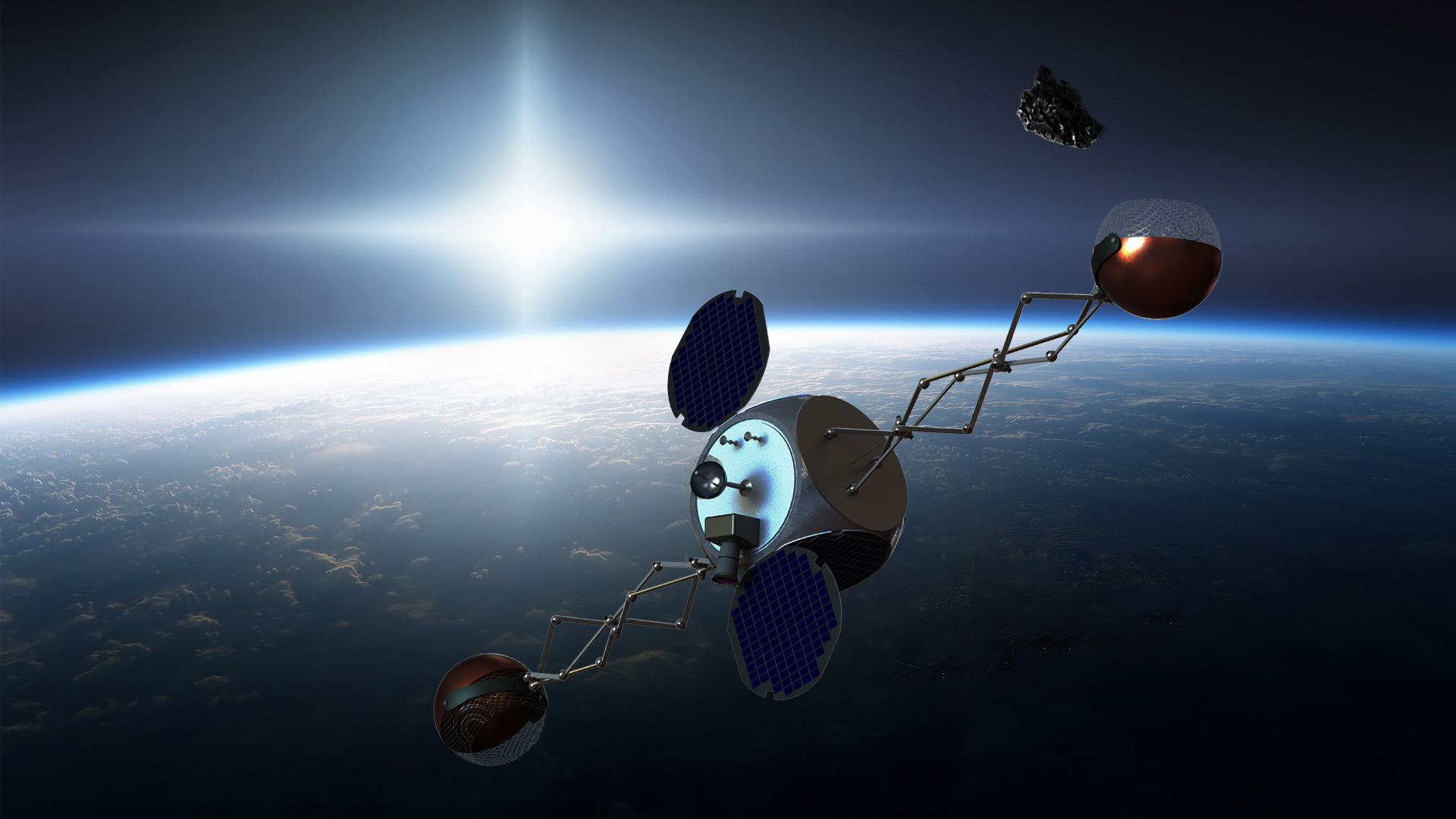
The concept involves deploying a “chase satellite” equipped with a harpoon mechanism capable of firing at debris targets. Once the harpoon embeds itself into the unwanted object, the chase satellite reels the debris in and guides it into Earth’s atmosphere, where it would harmlessly burn up upon reentry. This approach offers a controlled and deliberate means of debris disposal, mitigating the risks posed by uncontrolled reentries.
The harpoon prototype has already undergone successful testing on an old rifle range, where it penetrated aluminum panels similar to those used on satellites at speeds of 60 miles per hour. Dr. Jaime Reed, the inventor behind the technology, explained that space trials could commence as soon as four years from now, signaling a rapid advancement from concept to operational deployment.
Dr. Reed emphasized the urgency of the problem: “There’s a lot of stuff up there already that can, and will, come back to Earth. New satellites pose a threat to future satellites, so it’s something we need to look at and address.” His system aims to reduce the risk of future collisions by proactively clearing debris before it can cause harm.
__IMAGE_PLACEHOLDER_1__
Managing Reentry and Mitigating Risks
One of the major challenges with space debris is the unpredictability of its eventual descent. Uncontrolled reentries can result in debris falling anywhere on the planet, posing potential risks to populated areas. The infamous 1979 crash of the Skylab space station scattered debris across the Australian outback, illustrating the dangers of uncontrolled atmospheric reentries.
Dr. Reed’s harpoon system offers a crucial advantage: it enables operators to steer captured debris toward unpopulated regions such as the vast expanses of the Pacific Ocean. By controlling where and when debris reenters the atmosphere, this method drastically reduces the risk of harm to people and property on the ground.
“The advantage of our system is that it allows us to send space junk into unpopulated areas,” Dr. Reed said. “It’s a very robust and reliable method. We mustn’t create any more debris and we must have something that is very safe, and that’s the reason we’ve come up with the space harpoon.” This approach aligns with the broader international prioritization of sustainability in space activities and the prevention of further debris generation.
__IMAGE_PLACEHOLDER_2__
Why Addressing Space Debris Matters
The rapid expansion of satellite networks, especially with the rise of mega-constellations for broadband internet and Earth observation, intensifies the urgency to manage space debris effectively. Operational satellites underpin critical services including telecommunications, navigation, weather forecasting, and scientific research, all of which could be disrupted by debris collisions.
Moreover, human spaceflight ambitions continue to grow, with plans for sustained presence on the ISS, lunar missions, and eventual Mars expeditions. Ensuring astronaut safety requires a clean orbital environment, free from the threat of high-speed debris impacts.
International cooperation and technological innovation will be indispensable in tackling this complex challenge. The development of active debris removal systems like the space harpoon represents a significant step toward preserving the long-term viability of space activities.
Looking Ahead
As humanity’s reliance on space-based infrastructure deepens, the imperative to maintain a safe orbital environment grows ever stronger. Technologies such as the space harpoon offer hope for effective debris mitigation by enabling controlled capture and disposal of hazardous objects, thereby safeguarding both current and future space operations.
Ultimately, addressing space debris is not merely a technical challenge but a responsibility shared by all spacefaring nations. The ongoing development and deployment of debris removal technologies will be crucial to ensuring that the final frontier remains accessible and safe for generations to come.