Night Tube Launch Postponed Amid Ongoing Negotiations
The much-anticipated launch of London’s Night Tube service, originally scheduled for the early hours of 12 September, faces a delay as critical talks continue between Transport for London (TfL) and the Rail, Maritime and Transport (RMT) union. Despite the postponement, the RMT has confirmed its intention to proceed with planned strikes on specified dates, underscoring the tensions surrounding this landmark 24-hour transit initiative.
This delay highlights the complex negotiations behind one of London’s most transformative public transport developments in recent years. The Night Tube promises to revolutionize nighttime travel across the capital, yet it must overcome significant labor disputes before becoming operational.
What the Night Tube Means for London’s Nightlife and Economy
London has long been known as a global city that never sleeps, with a vibrant nightlife and round-the-clock activities. The Night Tube service aims to officially extend the Underground’s operating hours to support this lifestyle by providing continuous train service on Friday and Saturday nights. This initiative responds directly to a surge in late-night demand, with passenger numbers on Friday and Saturday nights having surged approximately 70 percent since the turn of the millennium.
By offering a reliable and frequent underground service through the night, the Night Tube will enhance accessibility across the city, connecting central London to its outskirts during hours previously served only by night buses, taxis, and private hire vehicles. This expansion is expected to bolster the capital’s night economy, supporting businesses such as bars, restaurants, theaters, and clubs, as well as improving safety and convenience for late-night workers and revelers alike.
The introduction of the Night Tube also signifies the culmination of years of investment and modernization within the London Underground network. These upgrades have improved infrastructure and rolling stock, making a 24-hour service feasible and sustainable.
Service Details and Future Expansion Plans
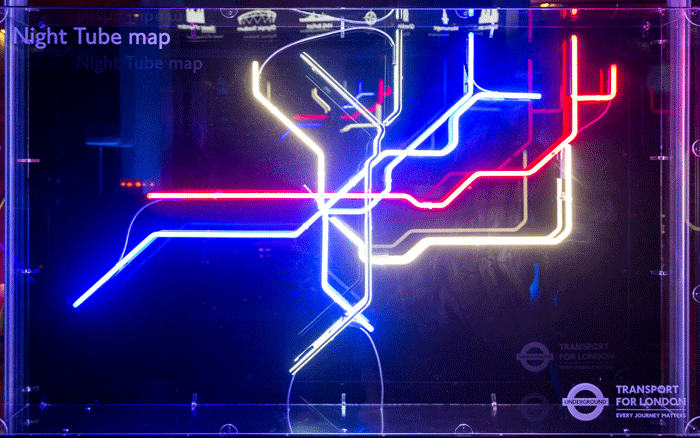
The Night Tube service will initially operate on five key Underground lines, with varying frequencies and coverage tailored to demand and operational constraints:
Jubilee and Victoria Lines
These lines will see trains running approximately every 10 minutes along their entire routes throughout the night, providing consistent and frequent service for passengers traveling across central and outer London.
Central Line
On the Central line, trains will run roughly every 10 minutes between White City and Leytonstone, the core stretch connecting central London. On the outer branches, including Ealing Broadway to White City and Leytonstone to Loughton or Hainault, trains will operate approximately every 20 minutes. Some sections, such as North Acton to West Ruislip, Loughton to Epping, and Woodford to Hainault, will not have Night Tube service initially.
Northern Line
The Northern line will feature trains approximately every 8 minutes between Morden and Camden Town, covering the busy southern section, with less frequent service, around every 15 minutes, from Camden Town to High Barnet and Edgware. Notably, there will be no service on the Mill Hill East and Bank branches during night hours.
Piccadilly Line
On the Piccadilly line, trains will run every 10 minutes between Cockfosters and Heathrow Terminal 5, ensuring access to central London and key transport hubs. However, there will be no service on the Terminal 4 loop or between Acton Town and Uxbridge during night service hours.

Looking ahead, Transport for London plans to extend Night Tube service to additional lines, including parts of the Metropolitan, Circle, District, and Hammersmith & City lines, as ongoing modernization projects reach completion. Furthermore, TfL envisions nighttime service expansions to the London Overground by 2017 and the Docklands Light Railway by 2021, which would further enhance London’s 24-hour transport network.
Why the Night Tube Matters for London’s Future
The Night Tube represents more than just extended operating hours: it symbolizes London’s commitment to evolving as a modern, global city that caters to the needs of its diverse population and economy. By enabling safe and efficient overnight travel, the Night Tube will facilitate employment opportunities with late or early shifts, reduce reliance on cars and taxis, and support tourism by making it easier to explore the city at all hours.
Additionally, the Night Tube stands as a testament to the importance of infrastructure investment and modernization in maintaining London’s status as a leading world city. However, the current industrial disputes remind us that progress relies on collaborative efforts between management and labor forces to deliver sustainable and equitable services.
As negotiations continue, Londoners and visitors alike await the launch of this transformative service, which promises to reshape nighttime mobility and invigorate the city’s vibrant after-hours culture.