

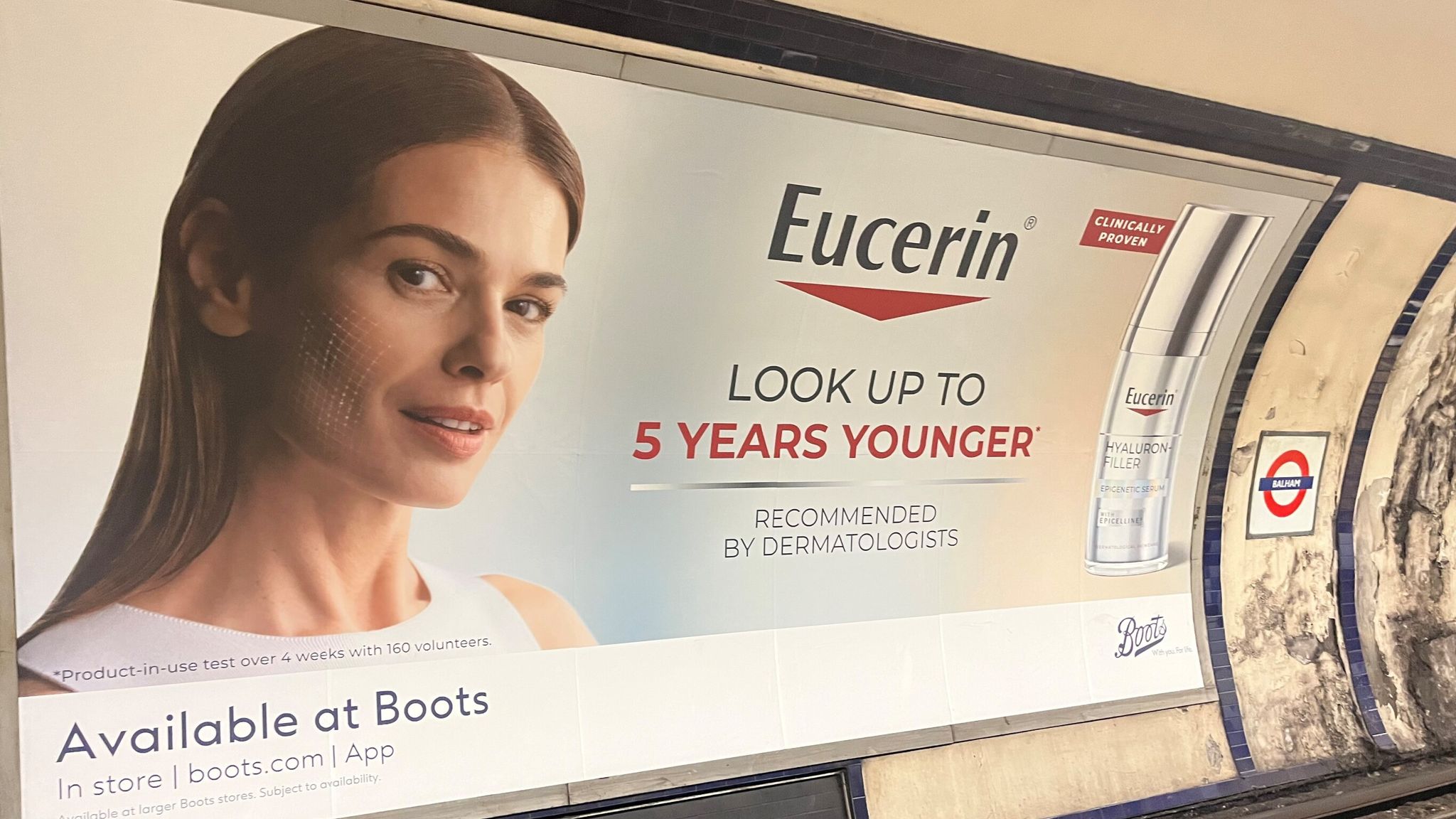
An eye-catching advertisement for the Eucerin Hyaluron-Filler Epigenetic Serum has been banned after the Advertising Standards Authority (ASA) ruled its claim that users could look “up to five years younger” was misleading and unsupported by sufficient evidence. The £49 serum’s poster, displayed prominently at Balham Underground station, sparked controversy by promising dramatic anti-aging results based on a short-term study. The ruling highlights growing scrutiny over skincare marketing claims and the need for rigorous scientific backing.
What Happened: The ASA’s Investigation into the Serum Ad
The banned poster featured a close-up of a woman’s face, with dotted highlights emphasizing her cheek area alongside the bold assertion that the serum could make skin appear up to five years younger within just four weeks. This claim rested on a study involving 160 volunteers, which Beiersdorf, the serum’s manufacturer, cited as evidence.
However, the ASA challenged the reliability of this research. It found the study lacked a control group, an essential element in clinical testing that helps isolate the effects of the product from other variables. Furthermore, the study did not clarify participant recruitment methods, raising concerns about sample bias.
The ASA also questioned the study’s methodology. While described as “blind,” the research failed to specify who was blinded—whether participants, researchers, or assessors. The application of the serum was neither standardized nor controlled for quantity, and participants were not restricted from using other skincare products simultaneously. Most importantly, the results were self-reported and subjective, which the ASA deemed insufficiently robust to substantiate such a definitive claim.
Scientific Concerns and Geographic Differences
The study took place in a country with a “hotter, sunnier climate” than the UK, involving participants with different skin types than typical UK consumers. The ASA noted this difference could reduce the applicability of the results to everyday UK conditions, undermining the ad’s claim for the local market.
Beiersdorf submitted additional studies and a peer-reviewed paper alongside the primary research. Yet, the ASA dismissed two of these studies due to similar methodological issues and labeled a fourth as irrelevant. The peer-reviewed paper examined only the serum’s active ingredient rather than the complete product and did not assess effects from daily use, which the ASA found inadequate for supporting the headline claim.
Consequently, the ASA concluded it had not seen “sufficient evidence to substantiate the claim that the serum was clinically proven to give a more youthful appearance of up to five years within four weeks.” The watchdog ordered that the advertisement must not run again in its current form and prohibited Beiersdorf from making this claim without robust proof.
Manufacturer Response and Broader Implications
Beiersdorf responded by affirming its commitment to scientific research underpinning its efficacy claims. The company stated: “All efficacy claims made in relation to Eucerin products are supported by scientific research.” It acknowledged the ASA’s ruling and confirmed that the billboard ad has been removed from the UK market.
The manufacturer emphasized that all cited studies comply with industry standards and expressed confidence in their products’ scientific backing. Despite this, the ruling serves as a reminder that skincare brands must ensure their marketing claims are transparent, well-supported, and reflect real consumer experiences under typical usage conditions.
Why This Matters: The Impact on Consumers and Skincare Advertising
This case underscores the vital role of regulatory bodies like the ASA in protecting consumers from exaggerated or misleading claims in the beauty industry. Anti-aging products often promise dramatic results, yet many rely on limited or flawed studies that do not translate into real-world effectiveness.
For consumers, this ruling encourages skepticism toward bold advertising assertions and highlights the importance of looking for products supported by rigorous, transparent research. For manufacturers, it signals that compliance with scientific standards and clear communication are essential to maintaining trust and avoiding sanctions.
As skincare innovation accelerates, regulatory oversight will remain critical in ensuring claims are not only compelling but also credible. This helps maintain a fair marketplace where consumers can make informed choices based on honest evidence rather than marketing hype.
In conclusion, the ASA’s ban on the Eucerin serum ad serves as a cautionary tale for the beauty industry. It stresses the necessity for robust, transparent evidence to support anti-aging claims and highlights the watchdog’s commitment to preventing misleading advertising. Consumers should stay informed and critically evaluate product promises while brands must uphold scientific integrity in their marketing strategies.