

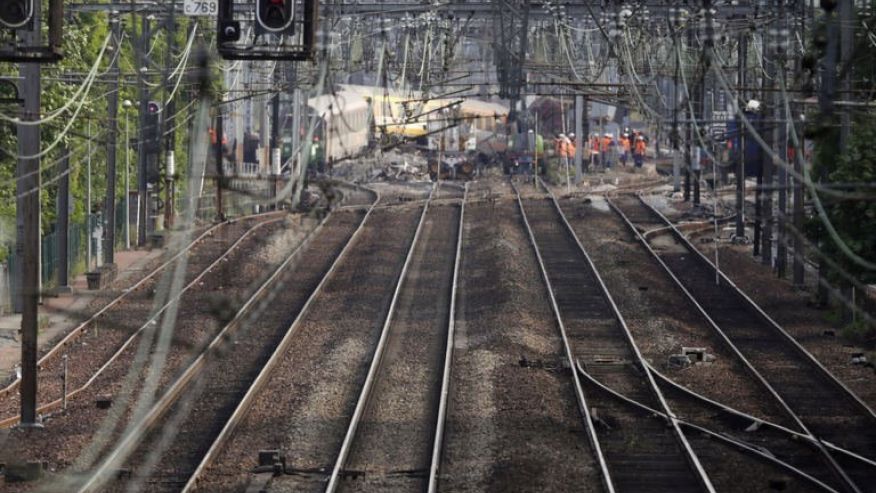
A devastating train derailment near Paris on Friday claimed the lives of at least six people and left dozens more injured, casting a dark shadow over the start of the summer holiday season in France. As families prepared to celebrate Bastille Day on July 14, the tragedy struck, disrupting festivities and prompting urgent investigations into the cause of the accident.
What Happened: The Cause Behind the Derailment
The derailment occurred just outside Paris on a heavily used railway line, as a train packed with passengers suddenly left the tracks. Preliminary findings from the train operator suggest that a critical mechanical failure played a central role. Pierre Izard, a general manager at the SNCF national rail company, revealed that a steel plate, commonly known as a fishplate, became dislodged from a track junction. This steel plate is designed to securely join rails at junctions, ensuring smooth and safe passage of train wheels over complex track segments.
According to Izard, the steel plate should have remained firmly bolted in place, but instead, it shifted into the middle of the track junction. This displacement effectively blocked the normal progression of the train’s wheels, causing the derailment. The detached joint acted as an obstacle, derailing the train cars and leading to the catastrophic event.
Guillaume Pepy, head of SNCF, emphasized that uncovering why the fishplate became dislodged is now the primary focus of the investigation. He also announced that the rail company would immediately conduct thorough inspections of approximately 5,000 similar track junctions across the French railway network. This proactive step aims to prevent a recurrence of such a mechanical failure elsewhere, highlighting the seriousness with which SNCF is treating the incident.
__IMAGE_PLACEHOLDER_1__
Rescue Efforts and Ongoing Search for Survivors
Following the derailment, emergency responders launched a massive rescue operation that extended into the night. Workers painstakingly cut through twisted metal and debris, searching for anyone who might still be trapped. The complexity of the wreckage was considerable: one carriage had toppled onto its side, while others were torn open by the force of the accident.
A crane was deployed to carefully lift the overturned carriage, allowing rescue personnel better access to the wrecked train cars. Despite the challenging conditions, no additional victims were discovered beyond those initially reported.
Michel Fuzeau, the prefect of the Essonne region where the accident occurred, acknowledged that there remained a possibility of finding more bodies within the wreckage or beneath the tilted carriage. However, he noted that rescue dogs had so far not detected further casualties. The operation continued with caution and thoroughness, with authorities determined to exhaust all possibilities before concluding the search.
Transport Minister Frédéric Cuvillier praised the quick reaction of the train driver, who managed to slow the train and avoid a collision with another train just 200 meters away. His swift response likely prevented a far worse disaster, demonstrating the critical importance of vigilance and training in railway operations.
__IMAGE_PLACEHOLDER_2__
National Impact and Response
The tragic derailment came at a sensitive time, as many French citizens were beginning their summer holidays and preparing for the national celebrations of Bastille Day, a symbol of French unity and freedom. The accident cast a somber tone over these festivities, reminding the nation of the fragility of safety even in everyday activities like travel.
French President François Hollande visited the crash site the following day to meet with the families of victims and offer condolences. His presence underscored the gravity of the event and the government’s commitment to supporting those affected. The tragedy also sparked a broader conversation about railway safety standards in France, which boasts one of the most extensive and heavily used rail networks in Europe.
Railway infrastructure in France is vital to the country’s economy and mobility, with millions of passengers relying on trains daily. Incidents such as this derailment highlight the critical need for rigorous maintenance and continuous safety upgrades, especially as aging components like fishplates face wear from decades of use.
__IMAGE_PLACEHOLDER_3__
Why It Matters: Lessons and Future Precautions
This derailment is a stark reminder that even small mechanical failures can have catastrophic consequences when it comes to rail safety. The dislodging of a single steel plate disrupted the entire system, leading to loss of life and injuries. This emphasizes the importance of meticulous track maintenance and regular inspections of vulnerable junctions.
The SNCF’s commitment to inspecting thousands of similar junctions nationwide signals a proactive approach to rail safety, aiming to identify and rectify potential weak points before they result in accidents. It also raises awareness about the challenges of maintaining a vast rail network, where thousands of components must work flawlessly in unison.
Moreover, the quick reflexes of the train driver demonstrate how human factors remain crucial even in highly automated transportation systems. Ongoing training and preparedness of railway personnel can make the difference between a manageable incident and a major disaster.
Looking ahead, the investigation’s findings will likely inform enhanced safety protocols and engineering standards. For the public, the incident serves as a sobering reminder of the complexities behind safe travel and the continuous efforts required to protect passengers on France’s railways.
As France mourns the victims and supports the injured, the broader railway community and authorities face the challenge of learning from this tragedy to prevent future derailments and safeguard the millions who depend on trains every day.