

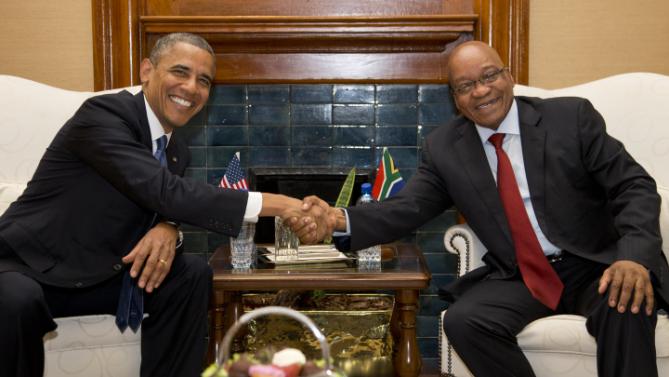
President Barack Obama arrived in Pretoria today to engage in high-level discussions with South Africa’s President Jacob Zuma, marking a pivotal moment in US-Africa relations amid a rapidly evolving continental landscape. The visit, part of Obama’s broader three-nation tour of Africa, underscores the strategic importance of South Africa as a gateway to economic opportunity and diplomatic partnership on the continent.
High Stakes Meeting in Pretoria
Touching down late Friday evening aboard Air Force One, President Obama’s arrival in South Africa was met with keen anticipation. His meeting with President Jacob Zuma is set against a backdrop of significant economic and political developments in the region. Despite widespread interest, Obama chose not to seek a hospital visit with the ailing anti-apartheid hero, Nelson Mandela. Instead, he emphasized a message of profound gratitude to Mandela’s family and the South African people for the late leader’s enduring legacy.
Speaking from Dakar, Senegal, before departing for South Africa, Obama remarked, “I did not need a photo op” with Mandela, underlining his respect for the privacy and dignity of the former president during his hospitalization. This stance reflects a nuanced approach to diplomacy, balancing symbolic gestures with substantive engagement.
__IMAGE_PLACEHOLDER_1__
Strengthening US-South Africa Trade and Investment Relations
At a televised press briefing, President Zuma warmly welcomed Obama and his delegation, highlighting the timely nature of the visit amid Africa’s economic resurgence. Zuma proclaimed, “Africa is rising. It is the second fastest growing region after Asia and has become an attractive market for investment.” This optimistic outlook reflects South Africa’s strategic pivot from the era of disinvestment imposed during apartheid to one of reinvestment and economic revitalization.
Zuma praised the United States’ strategy towards sub-Saharan Africa, launched the previous year, as “well-timed” to capitalize on this growth. The South African leader expressed strong optimism about deepening the US-Africa partnership, particularly in expanding bilateral trade and investment.
Currently, about 600 US companies operate in South Africa, collectively generating over 150,000 jobs. This robust commercial presence makes the US a major export market for South African goods, with South Africa representing the largest African market for US exports. Zuma noted that mutual trade volumes have rebounded to pre-global recession levels, signaling a healthy and growing economic relationship.
Looking ahead, Zuma called for increased investment in South Africa’s economy, emphasizing mutual benefits. He outlined a portfolio of “bankable projects” spanning infrastructure development and youth skills enhancement. This focus on youth development is critical, given that approximately one-third of South Africa’s population is under 15 years old. Such initiatives aim to equip the younger generation with the skills necessary to thrive in an increasingly globalized economy.
__IMAGE_PLACEHOLDER_2__
Addressing Broader Global Concerns
While economic ties were front and center, Zuma also addressed geopolitical issues, notably the ongoing Middle East peace process. He voiced South Africa’s concern over the lack of progress and stressed that achieving lasting peace requires addressing the broader regional challenges. Zuma acknowledged positive steps taken by the Obama administration, particularly efforts to relax longstanding restrictions, signaling cautious optimism about diplomatic breakthroughs.
Obama’s Perspective on Africa’s Investment Landscape
In response to concerns about competition for African markets, especially from China, President Obama adopted an inclusive stance. He stated candidly that the presence of multiple countries investing in Africa was beneficial, asserting, “The more countries that come to Africa, the merrier.” However, he also issued a clear cautionary note: African nations must remain vigilant to ensure that foreign investments align with the continent’s long-term development goals.
Obama emphasized that such investments must underpin regional integration efforts, industrialization, and the localization of supply chains and manufacturing. This strategic framework aims to transform Africa’s raw resource wealth into sustainable economic growth through value addition, job creation, and enhanced regional cooperation.
__IMAGE_PLACEHOLDER_3__
Why This Visit Matters
President Obama’s visit to South Africa comes at a critical juncture for both nations. For the United States, strengthening ties with Africa holds immense potential for economic growth, geopolitical influence, and fostering global partnerships in the 21st century. For South Africa, the engagement offers opportunities to attract investment, accelerate youth empowerment, and solidify its role as a continental leader.
The dialogue between Obama and Zuma reflects a shared commitment to expanding trade, enhancing mutual prosperity, and tackling pressing global issues collaboratively. It also reaffirms South Africa’s strategic importance as a hub of economic dynamism and political stability in sub-Saharan Africa.
As Africa continues its ascent as a fast-growing economic region, partnerships like the one between the United States and South Africa will play a decisive role in shaping the continent’s future. The success of this visit will be measured not only by immediate agreements but also by the enduring foundations laid for inclusive growth, regional integration, and sustainable development.
Ultimately, Obama’s visit highlights the evolving nature of international relations in Africa, where diplomacy, trade, and development are increasingly intertwined in pursuit of shared progress.